To be eligible to certify a K-9. You must be a full-time paid law enforcement officer (Reserve officer), paid full time fire fighter, or in the military with assigned search and rescue duties, or state licensed private security company, or corrections officer, member of a Search and Rescue K9 Team, either local, state, federal or retired law enforcement or correctional officer in good standing with the state you worked for prior to retirement. Be a volunteer actively involved in Search and Rescue, Fire fighter or EMS team. The handler must be at least eighteen (18) years of age to certify with a K9.
Sources, Distractors used:
- Human decomposition odors, such as tissue, human bones or fatty tissues shall be used as target odors.
- The amount and size used shall be left to the evaluator deaccession. No more than two pounds and bones shall not be more than 12 inches.
- Distractors: No human or animal waste shall be used as a distractor. Items shall be placed in a manner to prevent contamination. Distractors may consist of food items (cheese, etc.) Empty PVC pipes, clean empty Ziplock baggies or clear empty containers.
- Evaluator will do their best to conceal or secure testing/training materials in a manner that they cannot be consumed by testing canine. However, handler must recognize canine attempting to do so and correct or stop canine from doing so. If item in question is destroyed or consumed will consist of a failure of the test.
Shore line Certification
* No more than 150 yards in a marked area
*Source should be placed at least 30 minutes before and no longer than 24 hours prior to the certification start.
*Source will be placed out of sight.
*Canine should alert within the area of 1.5x depth of source. Example, if at 3 feet, should alert within 5 feet.
*Canine may work on or off lead, but under verbal control of handler.
* The duration of this evaluation can vary in time and are at the evaluator’s discretion based on actual size of the area provided and number of sources used.
* Canines must work independently. A trained final response must be indicated by canine and called by handler. A false final response that is called incorrectly by the handler will result in a failure to pass.
* If any animal bones or other natural distractions are inside the testing area, they shall be considered part of the environment.
Open Water Certification
*Shoreline certification to be completed before open water is done*
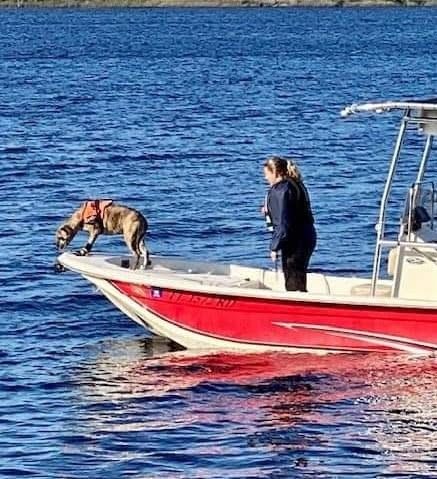
* All occupants on boat must wear Coast Guard Approved PFD (personal flotation device) at all times. Canine flotation vest is optional. Canine must wear a harness or vest with handler to assist removing canine from water if canine goes overboard.
*Source should be placed within 1 hour and no longer than 24 hours prior to the certification start within a 200-yard area with markers setting boundaries of area.
*Source should be placed at least between 3 to 8 yards minimum inside the search area and out of sight of the canine team.
*Canine must alert within the testing area, unless environmental changes determine a different outcome. The radius should contain 1.5 depth of source, example, if at 10 ft deep, canine should alert at 15.5 feet of source.
*The handler must be able to know where the location of source is within 1.5 times the depth of source. For example, if at 10 ft deep, canine should alert at 15.5 feet of source.
*The canine may work on or off lead, but under verbal control of handler.
*Canines must work independently. A trained final response must be indicated by canine and called by handler. A false final response that is called incorrectly by the handler will result in a failure to pass.
* The duration of this evaluation can vary in time and are at the evaluator’s discretion of actual times. This is determined by the number of sources used and size of the area provided.
* If any animal bones or other natural distractions inside the testing area shall be considered part of the environment.
If an alert is called on animal remains will result in a failed certification. The handler must show proficiency in reading the body language of the canine while searching. Wind direction, water current and speed must be taken into account. If canine team does not locate the sources of human remains in the time set forth by evaluator.
If it is clear to the evaluator that the canine is not working odor or handler is not properly reading the canine, the evaluator may stop the test. The canine marking/urinating on source/hide will result in failure. No use of electronic collars shall be used during testing. GPS collars may be used if approved by the evaluator before testing has started. Handler must maintain verbal or physical control of canine at all time.
CERTIFICATION IS VALID FOR ONE YEAR FROM DATE OF COMPLETION.